
Aluminium honeycomb panel
Aluminium Honeycomb Panel
A honeycomb core between two skins: 15 mm thick, about 6 kg/m², dead flat.
- 10–25 mm thickness
- 5.5–8.5 kg/m²
- ≤0.6 mm/m flatness
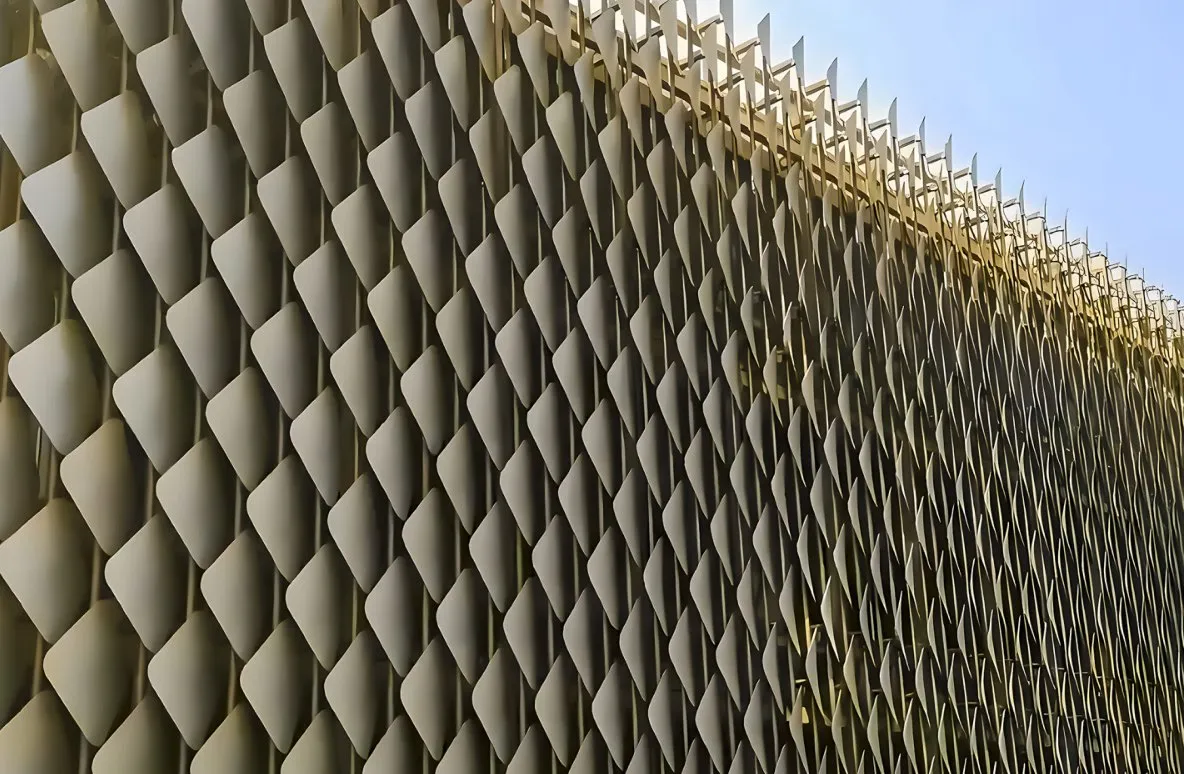
Overview
How the system is built
BLTC manufactures and exports this system to facade contractors, developers and importers in North America, the Gulf and Europe. A honeycomb panel is two thin aluminium skins bonded to a hexagonal aluminium core. The core does the structural work, so a 15 mm panel weighs about 6 kg/m² yet spans further and stays flatter than solid sheet of the same weight. That makes it the natural choice for large module sizes, long soffits and interiors where a single unbroken plane is the design intent.
Panels are produced on a continuous lamination line, then cut, folded or edge-filled to the project module. Because the skins are thin, edge treatment and fixing detail decide how the panel performs — we detail both with the sub-frame rather than leaving them to site.
Specifications
Aluminium Honeycomb Panel data
Ranges we manufacture to. Project values are fixed by calculation and confirmed on the approved shop drawings.
| Material | AA3003 skins 0.8 / 1.0 / 1.2 / 1.5 mm; 3003 hex core, 6 mm cell, 0.06 mm foil |
|---|---|
| Thickness | 10 mm, 15 mm, 20 mm, 25 mm |
| Surface finish | PVDF 70% KYNAR 500, 25–35 µm; anodized; mill finish for interiors |
| Maximum panel size | 1,500 × 4,000 mm; 1,500 × 6,000 mm on request |
| Fire rating | A2-s1,d0 to EN 13501-1 (aluminium core) |
| Flatness | ≤0.6 mm per metre — the flattest option in the range |
| Weight | 5.5–8.5 kg/m² depending on skin and core |
| Peel strength | ≥6 N/mm flatwise tensile, tested per batch |
| Acoustics | Rw 25–30 dB as a single-leaf panel; improved with insulation |
| Warranty | 20 years on coating and bond, project-specific |
Honeycomb panels are structural sandwiches: fixing positions and edge details must come from the panel supplier, not be improvised on site. We issue a fixing drawing with every order.
System details
Joints, movement and anchorage
The four details that decide whether the facade performs for twenty-five years. Project-specific drawings are issued for approval before production.
01
Core and bond
The core is expanded aluminium foil, 6 mm cell, bonded to the skins with a two-component adhesive under heat and pressure. Bond strength is tested by flatwise tensile on every batch, and panels are stored flat until packing.
02
Edge treatment
Edges are closed with an aluminium channel or filled with a structural insert, depending on whether the edge is exposed. An open honeycomb edge on a facade will collect water; we specify closed edges on every external panel by default.
03
Fixing and sub-frame
Panels are fixed through the edge channel into a sub-frame, or with a concealed cleat system for a joint-free look. Because the skins are thin, point loads must never be applied directly to the face.
04
Large-format modules
At 1.5 × 6 m the panel is usually the largest element on site, so handling and sequence matter as much as the panel itself. We pack in purpose-built crates and can supply a lifting plan for the module size.
Finishes
PVDF or anodized?
Both are factory-applied and both last decades. The choice is usually decided by colour range and by what the specification in your market recognises.
| Property | PVDF (70% KYNAR 500) | Anodized |
|---|---|---|
| Film build | 25–35 µm, 2- or 3-coat system | 15–25 µm, integral anodic layer |
| Colour range | Full RAL / NCS range, metallics, mica, wood-grain | Natural silver, champagne, bronze, black (limited) |
| Weathering | AAMA 2605 / EN 12206, 10-year Florida exposure | Excellent — the surface is not a coating |
| Colour stability | ΔE ≤ 5 after 10 years, standard colours | No coating to fade; colour is in the metal |
| Impact / abrasion | Good; touch-up possible on site | Very good; scratches are difficult to repair |
| Best suited to | Facades, panels, coastal and high-UV exposure | Interiors, entrance frames, exposed metallic look |
| Warranty | 20–30 years, project-specific | 10–15 years |
Powder coating is available as a third option for interior and low-exposure applications. For coastal projects we default to a 3-coat PVDF build at 35 µm minimum.
Downloads
Documents for your submission
Files are released per project so that the correct profile family and revision reaches your consultant. Request the set and we will send it with the quotation.
Where it is used
Typical applications
FAQ
Questions about this system
If your question is about a specific elevation, send it with the drawing — the answer is usually in the geometry.
Honeycomb or solid aluminium panel?
Is the honeycomb core combustible?
Can panels be curved?
Aluminium Honeycomb Panel
Send the elevation — we will price the package
Include the building height, the wind region and the glazing specification if you have it. We reply with a preliminary panel schedule, the applicable test reports and a quotation.